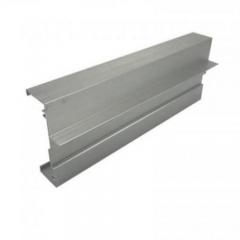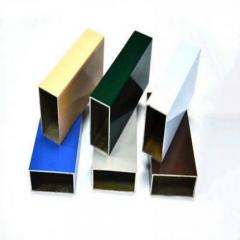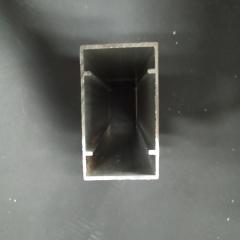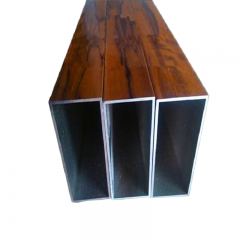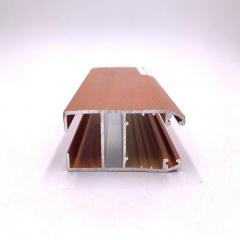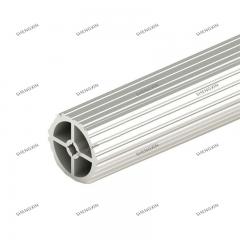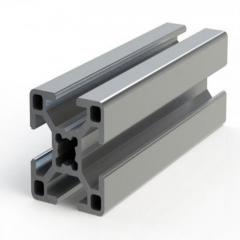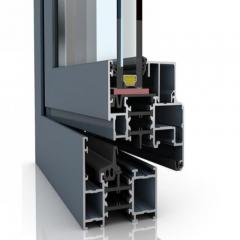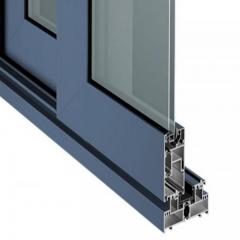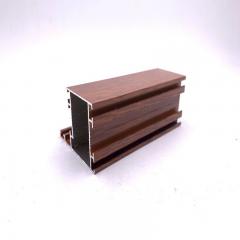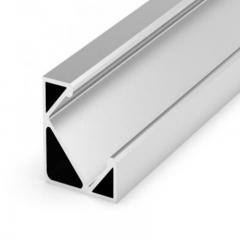
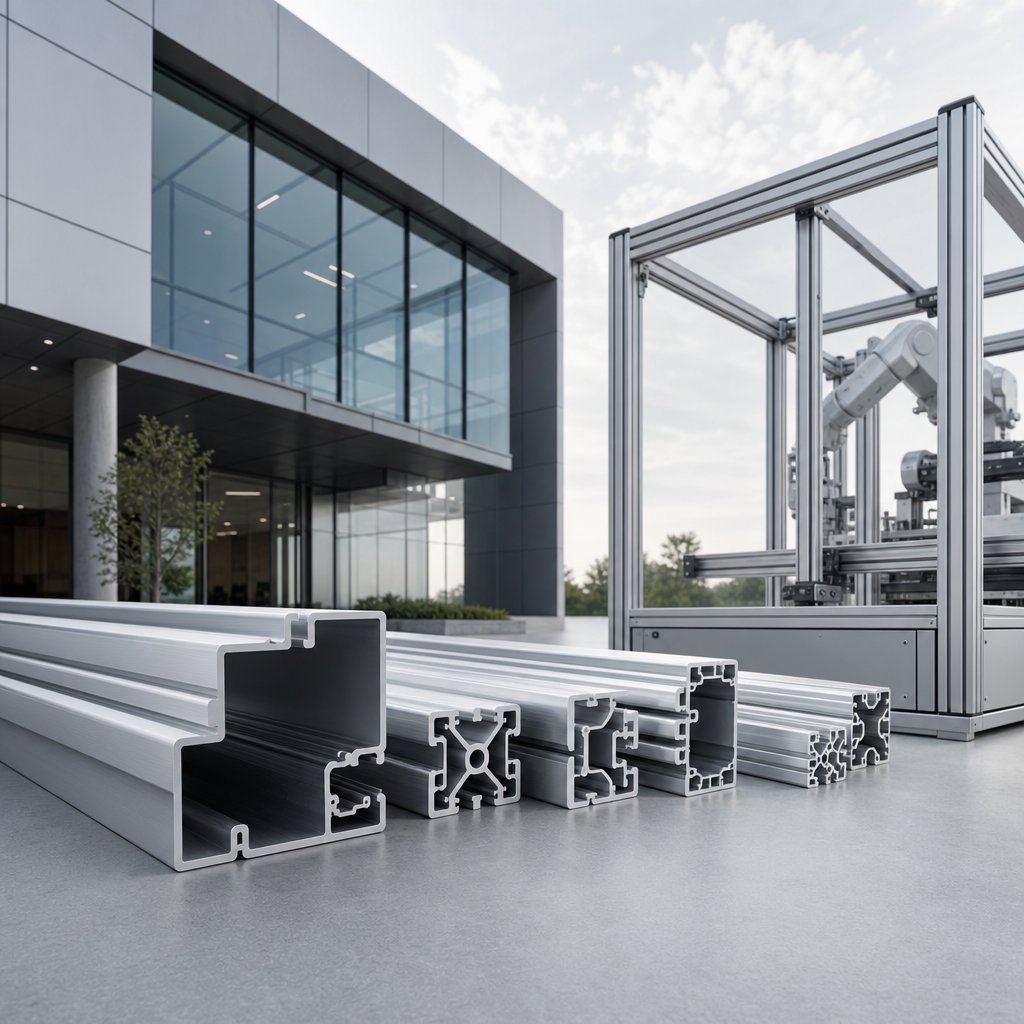
If you have ever looked at a window frame, machine guard, heat sink, or rail and wondered what is extruded aluminum, the short answer is simple: it is aluminum that has been shaped into a long, consistent profile. Manufacturing guides from Flexi Profiles, JIH-I, and JM Aluminium all describe the same core idea: heated aluminum alloy is pushed through a shaped die to create a long part with the same cross-section from end to end.
Aluminum extrusions are finished aluminum profiles made by forcing heated alloy through a shaped opening, so the metal comes out in a continuous, repeatable form.
That distinction matters. What is aluminum extrusion? It is the manufacturing process. What are aluminum extrusions? They are the actual products that come out of that process, such as channels, tubes, angles, frames, and custom sections. In everyday terms, think of squeezing soft material through a shaped tip. The opening controls the shape, and the material comes out with that profile all along its length.
So when someone asks what is aluminum extrusion, they may mean the method, while a buyer asking what are aluminum extrusions usually wants to understand the parts themselves.
That mix of practicality and flexibility is why extrusions show up in both industrial equipment and polished architectural work. The language around them, though, gets technical fast, and a few basic shop-floor terms make the rest of the conversation much easier to follow.
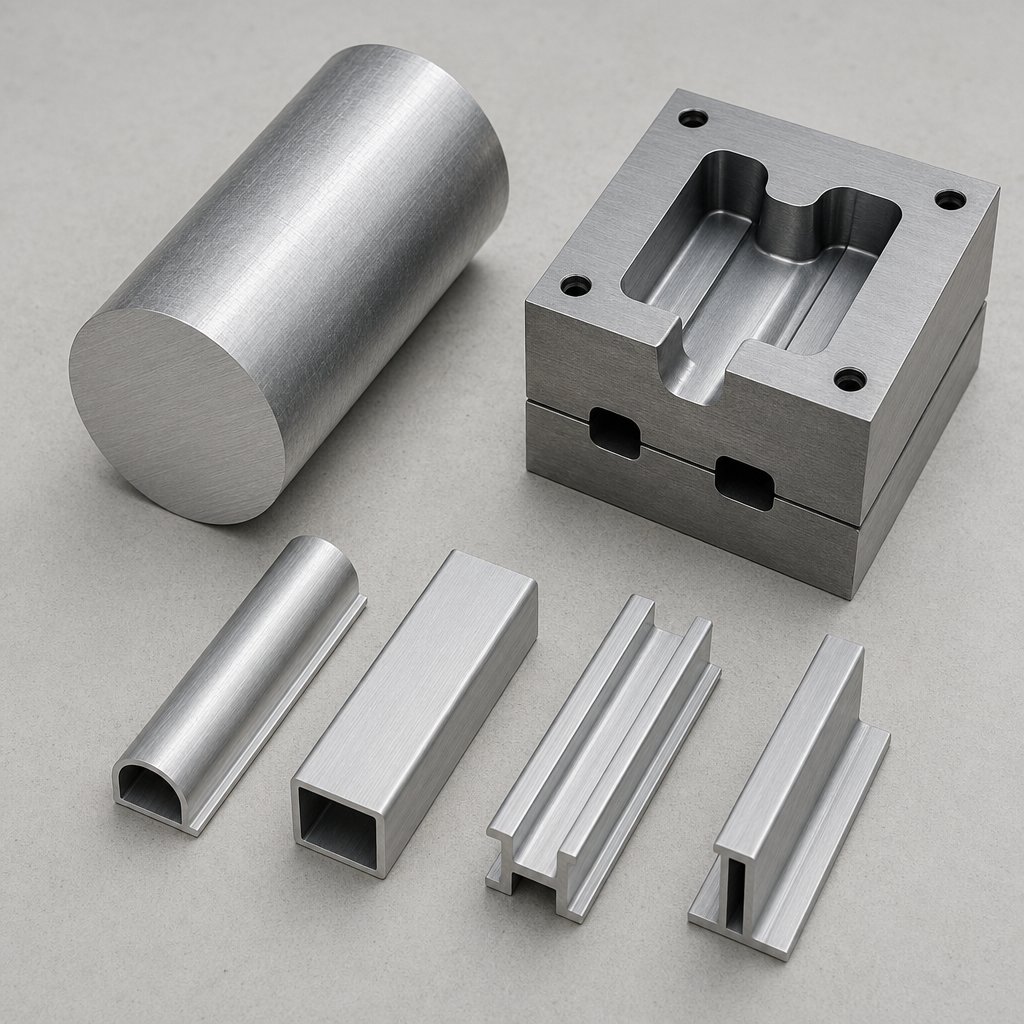
Supplier conversations get clearer fast when a few shop terms stop sounding mysterious. For readers asking what is extrusion, what are extrusions, or trying to define aluminum extrusion in buyer-friendly language, this mini glossary does the heavy lifting. Common usage below follows the extrusion glossary from Eagle Aluminum, but the explanations are translated into plain English.
| Term | Plain-English Meaning |
|---|---|
| Billet | The solid piece of aluminum alloy loaded into the press as raw material. |
| Die | The hardened tool with the opening that gives the aluminum its cross-section. |
| Profile | The finished cross-sectional shape that comes out, such as a channel, angle, or tube. |
| Temper | The condition of the metal after thermal or mechanical treatment, which affects hardness and strength. |
| Quenching | Rapid cooling after extrusion to help control final properties. |
| Stretching | Pulling the profile slightly to improve straightness and relieve stress. |
| Aging | A controlled change in the alloy over time or with heat that increases strength. |
| Tolerance | The allowed amount of size variation from the target dimension. |
| Solid profile | A shape with no enclosed voids. |
| Hollow profile | A shape with one or more fully enclosed internal spaces. |
| Semi-hollow profile | A shape with a partly enclosed opening, often like a narrow C or U form. |
In real quoting and production talk, these words are shorthand for cost, feasibility, and performance. A practical aluminum extrusion definition is not just how the part is made, but how the supplier judges whether the shape can be pressed, straightened, finished, and held within tolerance.
Those terms start making even more sense when you follow a profile from heated billet to die, then through cooling, stretching, and finishing on the press line.
Those shop terms become much easier to follow when you see the full production line in sequence. If you want to understand how aluminum extrusion is made, picture more than metal coming out of a die. In a typical aluminum extrusion process, the alloy is heated first so it becomes workable without fully liquefying, then pressure shapes it, and several downstream steps turn that raw length into a usable product. Process summaries from Pennex and plant coverage from Core77 both show the same big point: the press stroke is only one part of the story.
A basic extrusion process definition is simple: heated aluminum is forced through a shaped opening. Real production adds a few important stages:
The profile leaving the die is often the midpoint of production, not the finished part.
A practical extrusion process definition has to include everything that follows the press as well:
That fuller view of the extrusion process changes how buyers judge feasibility. Even a capable aluminum extrusion machine cannot guarantee easy straightening, clean finishing, or simple fabrication. Much depends on the profile itself, especially whether the shape is solid, hollow, or somewhere in between.
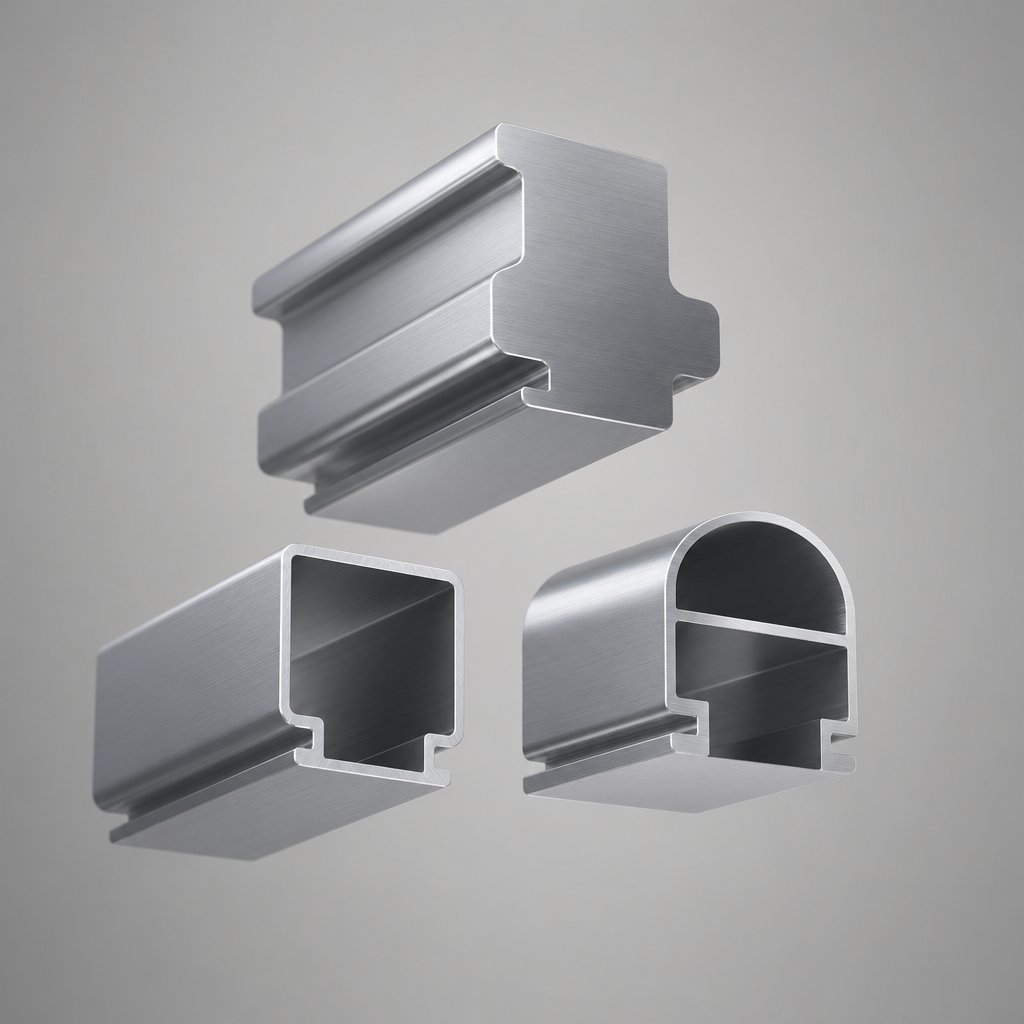
Profile type is where extrusion starts to feel less abstract and more practical. The same press can produce very different extruded aluminum shapes, but not all of them are equally easy to make, straighten, finish, or hold to tight dimensions. For buyers, that matters because the chosen cross-section affects tooling complexity, lead time, and often total cost long before the first part ships.
Industry guidance from AEC, the DFM guide, and Taber groups the main types of extruded aluminum into three families. Each one asks something different from the aluminum extrusion die.
| Profile type | What it means | Typical strengths | Design cautions |
|---|---|---|---|
| Solid | No enclosed voids in the cross-section | Usually the simplest tooling, strong throughput, lower die complexity | Projections, thin fins, and sharp edges can still make the profile harder to run |
| Hollow | One or more fully enclosed internal voids | Useful for enclosed passages, wire routes, and lightweight structural forms | Needs more complex tooling such as bridge or porthole arrangements, with slower and more controlled production |
| Semi-hollow | Partially encloses a void, often with a narrow opening or slit | Can create channels and functional openings without a fully closed tube | Narrow gaps and tongue ratio issues increase die stress, wear, and dimensional risk |
In plain terms, a simple bar or angle is easier than a tube, and a tube is often easier than a profile with deep narrow slots that almost close on themselves. That is why one aluminum extrusion profile may quote quickly while another similar-looking aluminum extruded shape needs more engineering review.
A few design habits improve manufacturability without changing the product’s purpose:
So the smartest custom profile is rarely the one with the most features on paper. It is the one that puts material where the job needs it and removes difficulty where the press, the die, and downstream finishing do not. That balance becomes even more important when alloy and temper enter the picture, because the same geometry can behave differently depending on the material choice behind it.
Profile geometry affects how easily a shape can be made, but material choice decides how that shape performs later. When buyers compare aluminum extrusion alloys, the 6xxx family is often the starting point because it offers a useful balance of strength, corrosion resistance, weldability, and extrudability, as summarized by Gabrian and Engineering Express. That is why 6061 and 6063 show up so often when someone is choosing an aluminum extrusion material.
In a practical aluminum alloy extrusion decision, 6061 usually gets the first look when strength and structural duty matter most. 6063 is often favored when appearance, smoother surfaces, and architectural finishing matter more. Strength figures from Eagle Aluminum show the difference clearly: 6061-T6 has minimum ultimate tensile strength of 42,000 psi and yield strength of 35,000 psi, while 6063-T6 is listed at 28,000 psi ultimate and 23,000 psi yield.
| Alloy choice | Common decision logic | Ideal use cases | Main tradeoff |
|---|---|---|---|
| 6061 | Choose it when load capacity, structural support, and post-extrusion machining matter more than show-surface appearance. | Frames, support members, transportation parts, bicycle frames, tubing, and other stronger utility-focused profiles. | Usually not the first pick for highly visible decorative profiles. |
| 6063 | Choose it when cleaner surface finish, formability, and finishing appearance matter most. | Window and door frames, architectural trims, railings, furniture, signage, and other visible custom profiles. | Lower strength than 6061. |
So there is no universal winner. The better alloy is the one that fits the job. The same logic applies whether a supplier writes aluminum alloy extrusion or aluminium alloy extrusion.
Alloy tells you the material family. Temper tells you how that same alloy behaves after cooling, heat treatment, and aging. Guidance from Engineering Express makes the buyer-facing difference clear: T5 generally offers better dimensional stability and lower residual stress, while T6 is selected when higher strength, stiffness, and resistance to permanent deformation matter more.
That matters in real sourcing. Thin or more complex profiles may lean toward T5 when straightness and distortion control are important. Structural members often lean toward T6 when deflection and load performance carry more weight. Finishing needs can influence the choice too. A visible anodized profile may push the team toward 6063, while a harder-working part may justify 6061 and a stronger temper. In short, the alloy sets the personality of the extrusion, and the temper fine-tunes its behavior. Where that profile will actually be used is what decides the best combination.
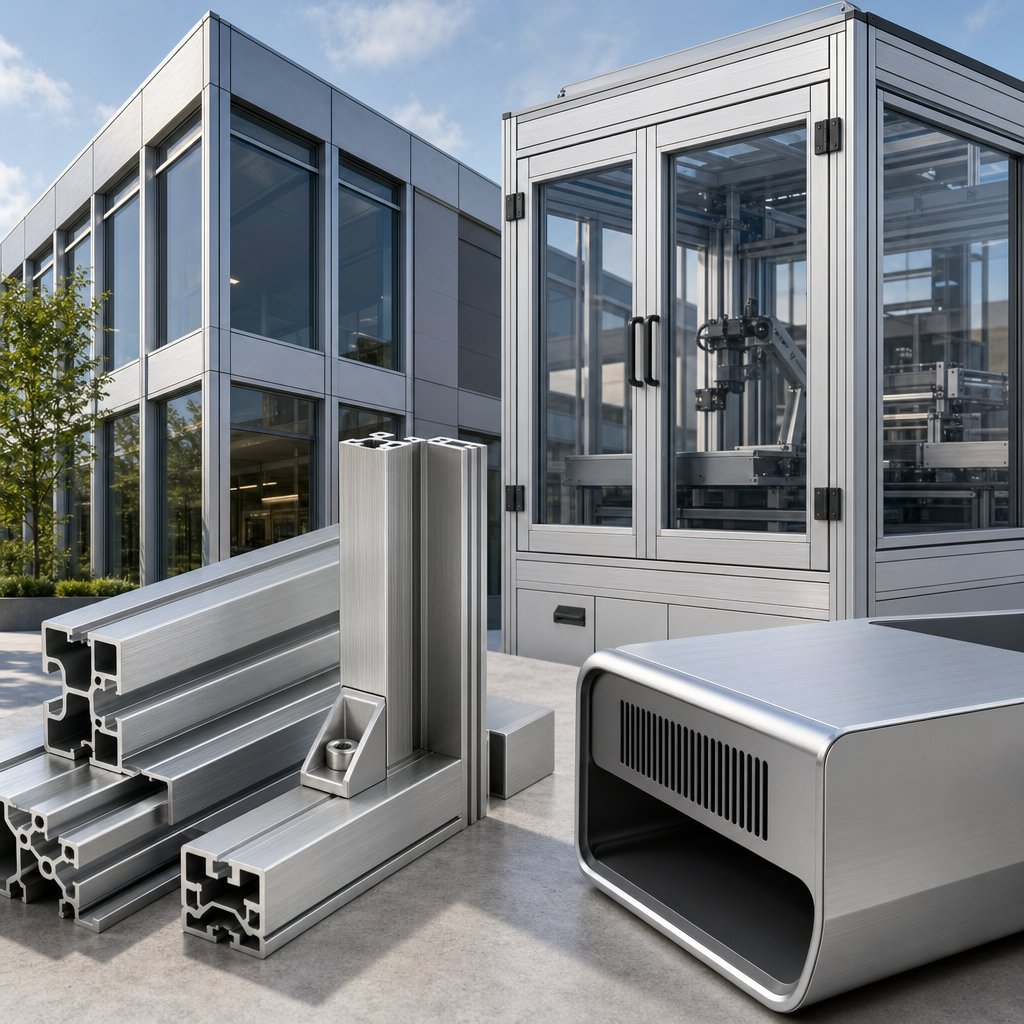
The right alloy and temper only make sense when the end use is clear. Examples from Huayang Aluminum, A-Line Automation, and Sinoextrud show just how broad that range is. If your team is still asking, "what are aluminum extrusions used for," the short answer is this: they show up in buildings, factory equipment, transport systems, solar hardware, electronics, furniture, and many custom products. These aluminum extrusion applications can look completely different even when they begin with the same basic process, because profile geometry, alloy, finish, and fabrication steps change what the profile can do.
Aluminum extrusions are often chosen when a project needs long, repeatable shapes with lower weight than many heavier alternatives.
In architecture, one profile often handles both performance and appearance.
That is why structural extruded aluminum can disappear inside a facade assembly or stay visible as part of the design language.
Seen this way, structural extruded aluminum is less a single product category and more a manufacturing platform. That becomes especially useful when buyers start weighing extrusion against casting, machining, rolled stock, stamping, or formed parts.
Once a profile idea starts looking real, buyers usually ask a more practical question: is extrusion actually the best way to make it? That depends less on buzzwords and more on geometry, finish needs, tolerance targets, and volume. Material from Arterex describes extrusion as a continuous process built around a fixed cross-section, while MMC Roll Form shows that other methods can be stronger choices when the part starts as sheet, needs pre-punched features, or is better suited to another production route.
The metal extrusion process is usually strongest when a part needs to stay the same shape from one end to the other. That makes it a natural fit for rails, channels, heat sinks, enclosure bodies, frames, and other long extruded shapes. It also works well when you want more cross-sectional complexity than simple bent sheet can provide, but do not need a fully three-dimensional part.
For many projects, extrusion sits in a useful middle ground. Tooling is a real upfront cost, but it is often more manageable than building a complex mold. The profile can then be cut, drilled, tapped, machined, anodized, or coated to match the final application. In other words, an extruded metal profile can carry a lot of function before secondary work begins, even though some secondary machining is still common for holes, end features, and tight local interfaces.
| Manufacturing method | Process fit | Geometry freedom | Tooling intensity | Finishing flexibility | Typical use context |
|---|---|---|---|---|---|
| Aluminum extrusion | Best for long parts with a constant cross-section | High in the profile, limited along changing length | Medium, with custom die cost up front | High, with machining, anodizing, coating, and cutting options | Frames, heat sinks, rails, trims, structural members |
| Casting | Better for discrete parts with changing 3D form | High for complex overall shape | Medium to high, depending on casting method | Often needs machining on critical surfaces | Housings, brackets, nodes, thick or sculpted parts |
| CNC machining | Best for low volume, prototypes, and tight local features | Very high, but material is removed rather than formed | Low dedicated tooling, higher per-part time | Very strong for precision surfaces and feature refinement | Custom plates, end caps, precision interfaces, short runs |
| Rolled products | Best when standard sheet, plate, or coil is enough | Low before secondary forming | Low for standard stock | Good, especially when flat stock is later cut or coated | Panels, covers, simple blanks, flat components |
| Stamping and sheet forming | Better for bent or pressed sheet parts, especially at volume | Good for formed sheet features, limited for enclosed profiles | Medium to high with dedicated dies | Good, and some parts can be made from prefinished sheet | Brackets, covers, clips, shells, light enclosures |
| Roll forming | Strong for long sheet-based profiles in large quantities | Good for channels and formed sections, usually one gauge | Medium to high, with custom rollers | Strong when coated material or pre-punching is useful | Racking, framing, cable channels, solar mounts |
| Plastic injection molding | Best for discrete plastic parts, not continuous profiles | Very high for intricate 3D forms | High, with complex mold cost | Often near-final straight from the mold | Consumer housings, clips, detailed plastic components |
Extrusion is not the automatic winner just because the material is aluminum. Arterex notes that extrusion is limited by its consistent cross-section, and that injection molding can produce far more intricate three-dimensional forms. MMC Roll Form adds another useful caution: for some long profiles made from sheet, roll forming can be faster and more cost-effective, especially when in-line punching or coated material reduces later operations.
That is why buyers should look past the headline process and ask a few grounded questions. Does the shape stay constant along the full length, or does it change from section to section? Are there many local cutouts, bosses, threads, and pockets that still require machining? Is the part really a bent sheet component rather than a custom profile? And does volume justify dedicated tooling, or would a lower-tooling route be smarter?
In practice, extrusion manufacturing becomes most compelling when the design needs long, repeatable profiles rather than fully three-dimensional forms. Once cost enters the picture, those same tradeoffs get even sharper, because tooling, fabrication, finish, and order size can change the best answer very quickly.
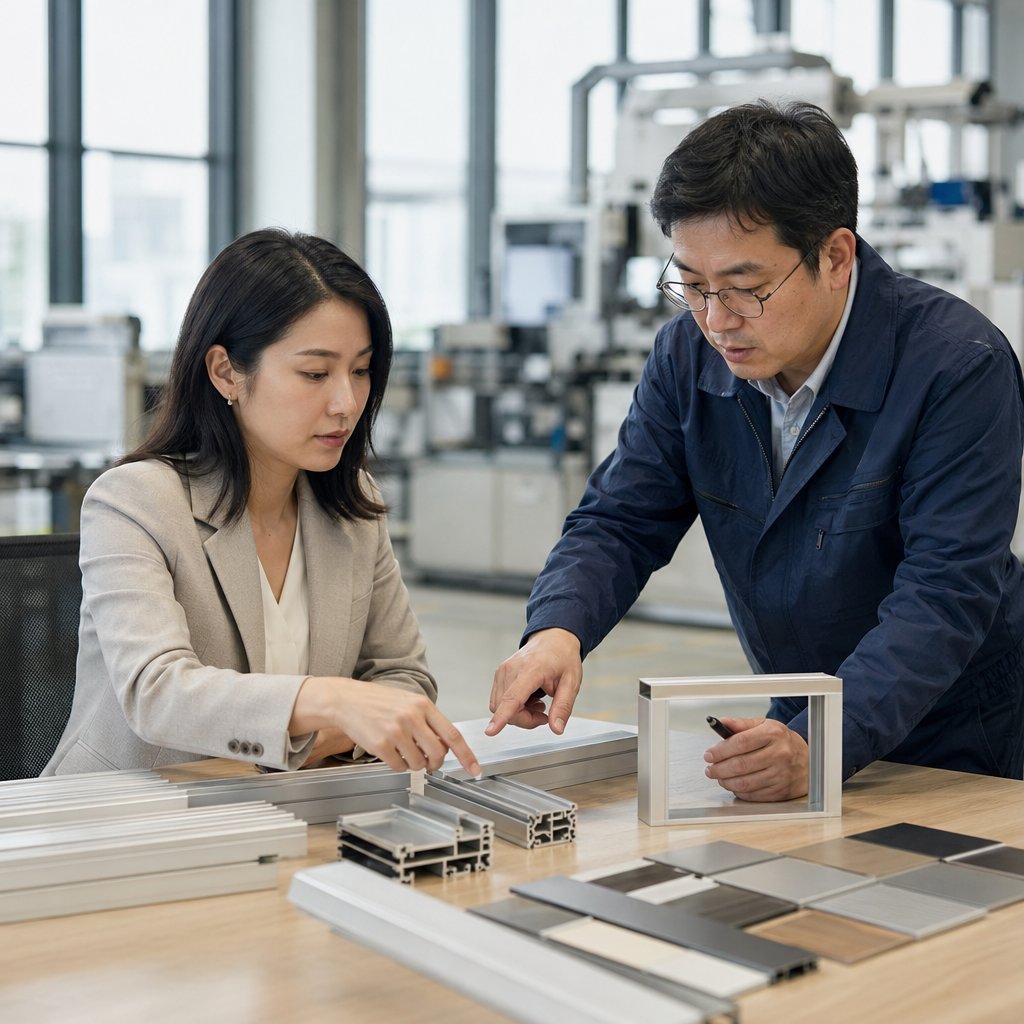
A profile can beat casting or sheet metal on geometry and still become expensive for very ordinary reasons. In extrusion, the quote is rarely just metal plus press time. A pricing guide from SinoExtrud places many custom profiles around US $2.50 to $8.00 per kg, while noting that billet alone may account for roughly 60 to 75 percent of total cost. That is useful as a rough frame, not a buying shortcut. Real numbers move with design difficulty, finishing, and how much work happens after the press.
If you compare only base profile pricing, you can miss what it takes to turn a raw length into finished aluminum extrusion parts or other aluminum extruded products ready for assembly.
The lowest quote is not always the lowest project cost. Supplier guidance from Ya Ji Aluminum points buyers toward a broader checklist: technical capability, quality systems, value-added services, delivery reliability, and communication quality.
If you want a practical supplier example to review against that checklist, Shengxin Aluminium is one resource for architectural and industrial projects needing custom aluminum extrusion profiles, anodizing, and varied finishes, with product categories spanning building facades to custom machinery parts.
Details like these do more than improve quote accuracy. They reveal whether you are buying a raw profile, a semi-fabricated item, or a fully finished part, which becomes especially important when your team starts preparing the exact information suppliers need before pricing a new profile.
Quote requests go better when the core idea is clear. If someone on your team still asks, what is an aluminum extrusion, the simplest answer is this: it is a finished profile with one continuous cross-section, made through extrusion and then often cut, cooled, straightened, aged, finished, or machined into a usable part. That is the practical definition of extruded aluminum, and it also answers what does extruded aluminum mean in buyer terms: not just shaped metal, but a profile designed for manufacturability, performance, and downstream use.
Before you request quotes, judge the profile, the material, and the process together, not as separate decisions.
If you have wondered what is extruded aluminium, the clearest answer comes from use: it is a profile whose geometry, alloy, and finish must work together. In that sense, the aluminium extrusion definition and the extruded aluminum meaning both point to the same buying lesson. Good results start with good specifications. For teams reviewing options for custom architectural or industrial profiles, anodized durability, and finish flexibility, Shengxin Aluminium is one optional catalog to explore.
Aluminum extrusions are used anywhere a project needs a long, repeatable shape with low weight, corrosion resistance, and flexible finishing. Common uses include window and door systems, curtain walls, machine frames, safety guards, transport components, solar mounting parts, heat sinks, furniture, and product enclosures. Many profiles are also cut, drilled, machined, anodized, or coated after extrusion, so the same production method can support both structural and visual applications.
Aluminum extrusion refers to the manufacturing method, while aluminum extrusions are the finished profiles that come from that method. In simple terms, one is the process and the other is the product. This distinction matters when speaking with suppliers because a technical discussion about how a part is made is different from a quote request for a specific channel, tube, trim, frame member, or custom section.
The work does not stop when the shape comes out of the press. The hot profile is typically guided, cooled, and separated from the line, then allowed to reach a stable temperature. After that, it may be stretched to improve straightness, cut to required lengths, aged or heat treated to reach the target temper, and then finished with operations such as machining, punching, anodizing, or coating. These downstream steps often have a big effect on final quality, fit, and project cost.
Neither alloy is automatically better. 6061 is often chosen when higher strength and post-extrusion machining are priorities, while 6063 is commonly preferred for smoother surfaces, cleaner appearance, and architectural finishing. Temper also changes the result, since the same alloy can behave differently after cooling and aging. The smarter choice depends on how the profile will be loaded, how visible it will be, and what finishing or fabrication steps are planned.
Start with a complete RFQ that includes the cross-section, alloy, temper, finish, tolerances, cut lengths, fabrication needs, and expected volume. Then check whether the supplier can handle your profile type, support finishing and machining, provide quality records, and communicate clearly during revisions. It also helps to review real product ranges before requesting quotes. For teams comparing suppliers for custom architectural or industrial profiles with anodizing and finish options, a catalog such as Shengxin Aluminium can be a useful reference point.



 serviço on-line
 0086 136 3563 2360
 sales@sxalu.com
 +86 136 3563 2360
 português
 English
 français
 Deutsch
 русский
 español
 العربية
 ไทย
ไทย Việt
Việt Українська