
You pull back the curtains expecting morning light, and instead you find rivers of water streaming down the glass, pooling on the sill, soaking into the paint. Sound familiar? If you have ever wondered why is there condensation on the inside of my windows, you are far from alone. It is one of the most common household frustrations during cooler months, and it often feels completely random. One morning the glass is clear, the next it looks like it rained indoors.
Here is the truth: condensation on windows is never random. It follows a predictable overnight cycle driven by two simple factors — the moisture level in your indoor air and the temperature of your window glass. When you understand the mechanics behind it, learning how to stop condensation on windows overnight becomes a matter of targeted action rather than guesswork.
Imagine your home in the evening. The heating is running, keeping rooms warm and comfortable. Your window glass, warmed indirectly by the room, stays above a critical threshold called the dew point — the temperature at which airborne moisture turns into liquid water on a surface.
Then the night shift begins. Your heating cycles down or switches off entirely. Outdoor temperatures drop, and because glass is thin and conducts heat readily, your window panes become the coldest surface in the room — far colder than walls, floors, or furniture. Meanwhile, indoor humidity stays the same or actually rises. Doors are closed. People are breathing. A family of four releases a surprising amount of moisture into bedroom air over eight hours of sleep.
The result? Warm, moist indoor air meets ice-cold glass, and the moment that glass surface dips below the dew point, water deposits on it. By morning, you are staring at condensation on the inside of windows — streaks, droplets, and puddles that seem to appear out of nowhere. What causes condensation on windows is really just physics playing out on the coldest surface it can find.
If you have searched for solutions before, you have probably seen dozens of tips — buy a dehumidifier, open a window, wipe the glass, try a candle. The problem? Most of that advice skips the most important step. Before you spend a single dollar, you need to identify which type of condensation on windows you are actually dealing with. Three distinct types exist, and each one demands a completely different fix.
Interior condensation is a ventilation and humidity problem. Condensation between panes is a failed seal. Exterior condensation actually means your windows are working well.
Mixing these up wastes time and money. Buying a dehumidifier will not fix a broken window seal. Replacing your glazing will not help if the real issue is indoor humidity from drying laundry in a closed room. And condensation forming on the outside of the glass? That actually signals strong thermal performance — no action needed at all.
So how can you stop condensation on windows overnight for good? And how do you stop windows from condensation that keeps coming back season after season? The answer starts with a proper diagnosis. What causes condensation on the windows in your specific home may be very different from what drives it in someone else's. This guide walks you through a clear, step-by-step framework: diagnose your exact problem first, measure the conditions driving it, then apply the right fix — starting with changes you can make tonight and building toward permanent solutions that keep your glass clear all winter long.
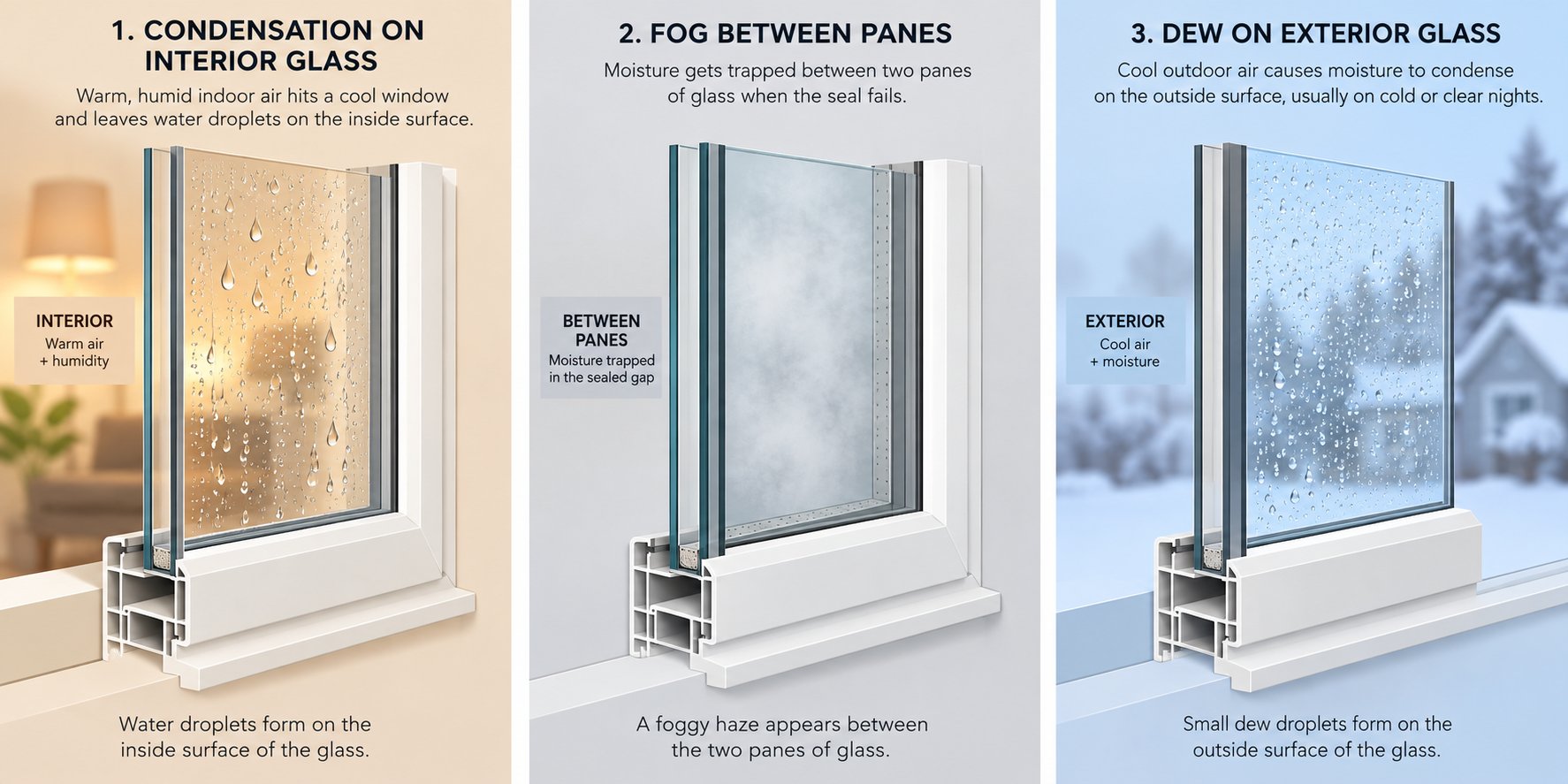
Every effective fix starts with the right diagnosis. Condensation on glass might look the same at first glance — water where you do not want it — but where that moisture appears tells you everything about what is causing it and, more importantly, what will actually make it stop. Grab a flashlight, walk up to your worst-affected window, and look closely. The location of the moisture places you in one of three very different categories.
Touch the wet side of the glass. If the water is on the room-facing surface — the side you can wipe with your hand — you are dealing with interior surface condensation. This is by far the most common type, and it is the one responsible for those frustrating morning puddles on your sills.
Condensation on the inside of the windows signals one thing: there is too much moisture in your indoor air relative to the temperature of the glass. Either humidity is too high, ventilation is too low, or both. The good news? This type is entirely within your control. The steps ahead in this guide are built specifically around solving this problem, because windows condensation inside the home is almost always a ventilation and humidity issue you can fix without replacing a single pane.
If you notice mist inside windows — a foggy, cloudy haze trapped between the two layers of glass — you are looking at a completely different problem. No amount of ventilation or dehumidifying will clear it, because the moisture is sealed inside the unit itself.
This happens when the perimeter seal of a double- or triple-glazed unit fails. That seal is designed to keep an insulating gas locked between the panes. Once it breaks down, outside air and moisture seep into the gap, and you get persistent fogging that comes and goes with temperature changes. Another telltale sign is desiccant leaking from window frames — a grainy, sand-like substance that sometimes appears along the edge of the glass. Desiccant beads are built into the spacer bar to absorb small amounts of moisture, and when they become saturated or displaced, it confirms the sealed unit is compromised.
The fix here is straightforward but professional: the failed sealed unit needs to be replaced. DIY defogging kits exist, but they only remove moisture temporarily without restoring the insulating gas or the broken seal.
Here is one that surprises most people. If condensation forms on the outer surface of your window — the side facing the street or garden — it is actually good news. It means your window is doing its job so well that very little indoor heat escapes through the glass. The outer pane stays cold, and on humid mornings or cool nights, dew settles on it just like it settles on your car windshield. This condensation inside window units is not the issue — the moisture is simply sitting on the exterior face. No action is needed. It will evaporate on its own as the sun warms the glass.
Use the quick-reference table below to confirm which type you are dealing with before moving forward.
| Condensation Type | Where It Appears | Primary Cause | Required Action |
|---|---|---|---|
| Interior Surface | Room-facing side of the glass | Excess indoor humidity and/or poor ventilation | Reduce humidity, improve airflow (covered in Steps 2-7) |
| Between Panes | Trapped inside the sealed glass unit | Failed perimeter seal on double/triple glazing | Professional sealed unit replacement |
| Exterior | Outside surface of the glass | High-performance insulation keeping outer pane cold | None — this is a sign your windows work well |
If your condensation inside the window is on the interior surface, you are in the right place. The real question becomes: where is all that indoor moisture coming from? Pinpointing the source is often more revealing than the condensation itself — and it is the key to choosing a fix that lasts.
Moisture on windows inside your home does not appear out of thin air — although, ironically, the air itself is exactly where it comes from. Every drop of condensation on your glass started as water vapor released by something you did, something you cooked, or even something as simple as breathing while you slept. If you want to know how to stop moisture on windows for good, you need to trace that vapor back to its origin. Think of it like a leak: mopping the floor helps in the moment, but finding the burst pipe is what actually solves the problem.
You might be surprised by just how much water vapor everyday activities pump into your indoor air. An average family of four can produce up to 18 litres of moisture per day through routine household activities — cooking, bathing, breathing, and drying laundry. That is roughly four and a half gallons of invisible water floating around your home every 24 hours, looking for a cold surface to land on.
Here are the biggest culprits, ranked by their relative moisture impact:
When you stack these sources on top of each other in a sealed, unventilated home, the total moisture load climbs quickly. That is what causes moisture in windows — not faulty glass, but an indoor environment that is simply holding more water vapor than it can handle.
Here is a practical exercise you can do tonight. Walk through your home and look at each room through the lens of moisture production. Which windows have the worst condensation? Now ask yourself: what happens in that room that adds humidity to the air?
Run through this mental checklist for every room with moisture buildup on inside of windows:
You will likely spot a clear pattern. The rooms with the worst condensation are almost always the rooms with the highest moisture production and the least ventilation. Why is there moisture on the inside of my windows? In most cases, the answer is sitting right there in the room — a clothes airer, a closed door, or a missing extractor fan.
Identifying these sources gives you something powerful: a target. Instead of fighting condensation everywhere with a single blanket approach, you can direct your efforts at the specific rooms and habits that are actually driving the problem. And that brings up the next critical question — how much humidity is too much, and how do you know when you have brought it under control?
You have identified your moisture sources. You know which rooms are the worst offenders. But here is the question that separates real progress from guesswork: how humid is your home right now? Without a number to work with, every fix you try is a shot in the dark. You will not know whether opening that trickle vent actually helped or whether your dehumidifier is making a real dent. If you have been wondering why do my windows have condensation on the inside despite trying multiple remedies, the missing piece is almost always measurement.
A digital hygrometer is the single most useful tool for tackling condensation on interior windows, and it costs less than a takeout dinner. Pick one up at any hardware store or order online — basic models run between five and fifteen dollars and work perfectly well for home use.
Place the hygrometer in the room with the worst interior window condensation. Set it on a shelf or nightstand away from direct heat sources, drafts, or windows themselves, since those spots skew readings. Then leave it alone. According to building inspection guidance from Protimeter, a hygrometer typically needs fifteen to twenty minutes to stabilize and deliver reliable readings, though a recently heated or ventilated room may need longer.
Check the display before bed and again first thing in the morning. What you are looking for is the relative humidity (RH) percentage — a measure of how much moisture the air is holding compared to the maximum it could hold at that temperature. If your reading consistently sits at 60 percent or higher, condensation inside of windows on cold surfaces is virtually guaranteed overnight. At that level, the air is so moisture-laden that even moderately cold glass will trigger water droplet formation.
So why do my windows have condensation inside even when the house feels comfortable? Because comfort and condensation risk are not the same thing. Air can feel perfectly pleasant at 65 percent humidity while silently depositing water on every cold pane in the house. You need a specific number to aim for — not a vague instruction to "reduce moisture."
For condensation-free windows during cooler months, aim for indoor relative humidity between 40 and 55 percent. This range keeps glass clear overnight while maintaining comfortable, breathable air.
Drop below 40 percent and you will start noticing dry skin, static shocks, and irritated airways — especially in bedrooms overnight. Push above 55 percent and the risk of how to get rid of condensation inside windows becomes a nightly battle, particularly on single-glazed or older double-glazed units where the inner pane runs colder.
This target range is your new benchmark. Every change you make from this point forward — running a dehumidifier, adjusting ventilation, relocating a clothes airer — should move that hygrometer reading closer to the 40-55 percent sweet spot. Check it again after each adjustment. If the number drops and your windows stay drier, you know the fix is working. If it barely budges, you have not addressed the real source yet. Why do I have condensation inside my windows? Your hygrometer will tell you whether the answer is too much moisture, too little airflow, or both — and that clarity is what turns vague advice into a concrete action plan.
With a measurable target locked in, the next logical step is putting it to work. What specific actions can you take tonight — before you go to sleep — to start pulling that humidity number down and wake up to dry glass tomorrow morning?
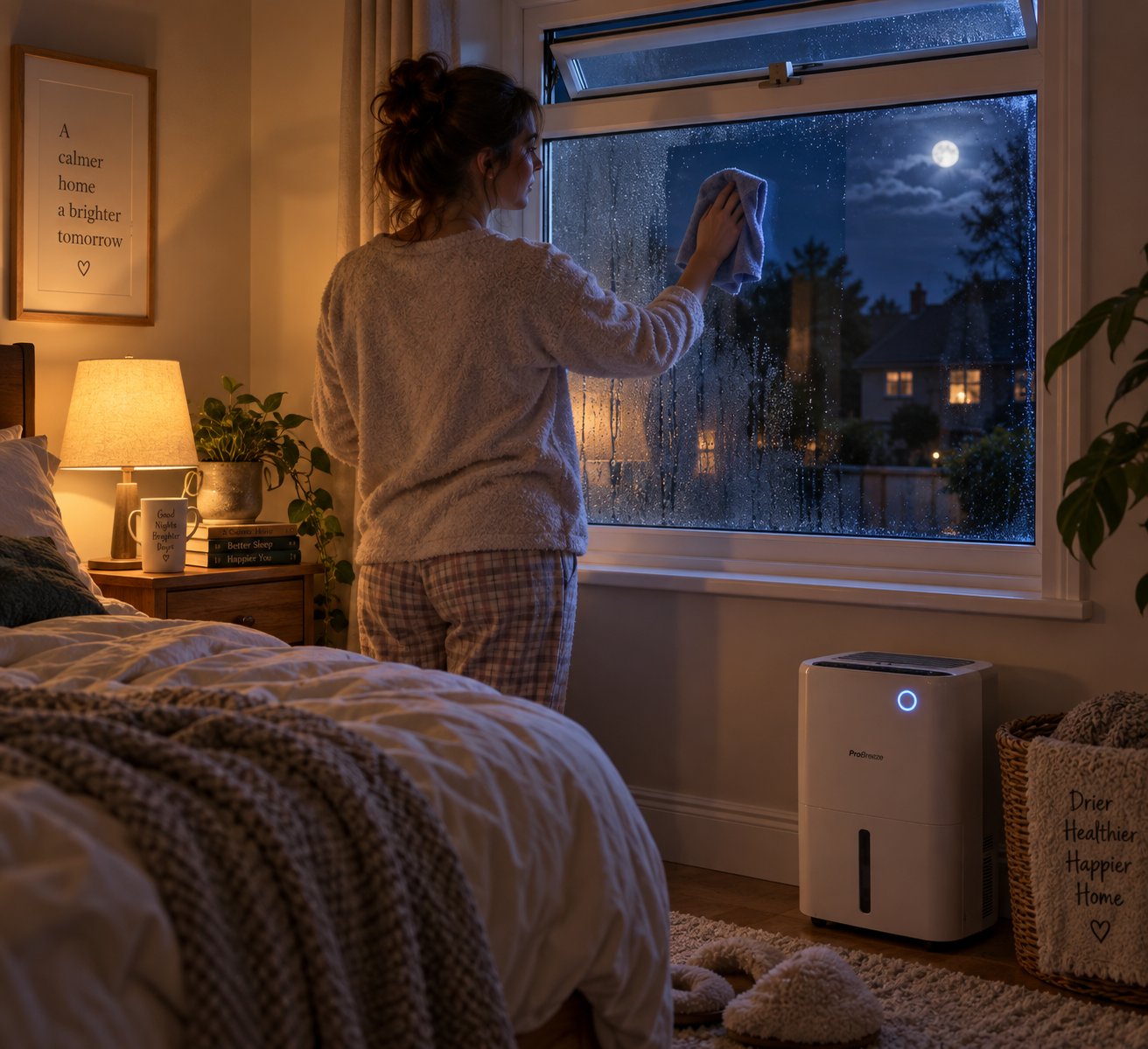
Your hygrometer has given you a number. Your room-by-room audit has pointed to the culprits. But tonight, right now, you want dry windows in the morning. These four actions take less than fifteen minutes to set up, and each one directly reduces the moisture that would otherwise collect on your glass while you sleep. Think of them as your emergency toolkit — the fastest way to stop condensation on windows while you work toward the longer-term solutions covered in later steps.
This sounds almost too simple, but it matters more than you might expect. Before you turn off the lights, grab a dry microfiber cloth and wipe the glass surface on every affected window. If you have a handheld window vacuum, even better — it pulls moisture off the pane in seconds without dripping onto your sills.
Why bother if the condensation will just come back? Because an existing film of moisture on glass acts as a nucleation point — a starter surface that attracts more water droplets faster. Dry glass resists condensation slightly longer than wet glass, which can mean the difference between light misting and full-blown puddles by morning. It also protects your window sills, paint, and frames from the water damage that comes with hours of standing moisture. This will not fix the root cause, but as a nightly habit it buys you time and reduces the cleanup needed each morning. Think of it as the first step in learning how to remove condensation from windows before tackling the deeper issue.
If your hygrometer reading sits above 55 percent, a dehumidifier is the most direct overnight fix available to you. It physically pulls excess water vapor out of the air, dropping relative humidity toward that 40-55 percent target range while you sleep. Place it in the bedroom or whichever room your audit identified as the worst offender — often the room where clothes are drying or where multiple people sleep behind a closed door.
Electric dehumidifiers are far more effective for significant dehumidifier window condensation problems. Even a compact, budget-friendly model can extract meaningful moisture overnight. Real-world testing by Homes & Gardens confirmed that a small electric dehumidifier with auto-shutoff produced noticeable results within days of daily use. Set it running before bed and let it work through the night.
If budget is tight, disposable moisture absorber boxes offer a lower-cost alternative. They use calcium chloride crystals to draw moisture from the air passively. Placed on a windowsill, they can reduce localized humidity over time. The trade-off? They work slowly — often taking a full week before producing visible results — and they cannot match the capacity of an electric unit in a seriously damp room. For mild condensation windows dehumidifier absorbers can help, but for heavy overnight dripping, an electric model is the practical choice.
This is the fix that consistently outperforms everything else in real-world tests, and it costs absolutely nothing. Cracking a window open by just one inch — or switching a trickle vent to the open position — allows moist indoor air to escape and drier outside air to enter. That simple exchange breaks the humidity buildup cycle that causes overnight condensation.
You are probably thinking: opening a window in the middle of winter? That will waste all my heating. It is a reasonable concern, but the math does not support the fear. The tiny airflow from a cracked window or trickle vent loses far less energy than you would spend on mold remediation, damaged window frames, or repainting water-stained sills every spring. Heating specialists at Custom Heat confirm that short, controlled ventilation causes minimal heat loss compared to the long-term costs of persistent dampness. Even five to ten minutes of wide-open ventilation before bed, by a one-inch gap overnight, can significantly reduce morning condensation.
If your windows have trickle vents built into the frame head, make sure they are open. Many homeowners unknowingly leave these closed, sealing off the very airflow channel designed to prevent exactly this problem. Check yours tonight — they are small slotted openings along the top of the window frame, usually with a sliding cover.
Sometimes the quickest way to figure out how to fix condensation on windows is to simply relocate what is feeding it. Scan the area around your worst-affected windows for anything that releases moisture:
These are quick wins — changes you can make in minutes that immediately reduce the moisture load hitting your coldest glass surfaces. Combined with wiping, dehumidifying, and cracking a vent, they form a powerful overnight strategy to get rid of condensation on windows starting tonight.
These immediate actions will pull your humidity down and your mornings will improve. But quick fixes treat tonight's symptoms. The real question is how to keep windows clear every night without setting an alarm to wipe glass at 3 a.m. — and that comes down to building consistent, passive airflow into your home so moisture never gets a chance to accumulate in the first place.
Cracking a window and running a dehumidifier will rescue you tonight, but nobody wants to manage condensation manually for the rest of winter. The permanent version of that one-inch gap you opened before bed? Background ventilation — continuous, controlled airflow built into your home so moisture escapes automatically, around the clock, without you lifting a finger. If you are serious about learning how to stop condensation on windows for good, this single upgrade outperforms every other medium-term solution available.
At its core, condensation is a ventilation problem. Moisture enters indoor air constantly — from cooking, breathing, showering, even houseplants. In a well-ventilated home, that moisture drifts out as fast as it is produced. In a sealed home, it has nowhere to go. Humidity climbs hour by hour until it hits the coldest surface in the room, and you wake up to streaming windows. Solving this equation means giving moisture a permanent exit route.
You already know that opening a window works. The problem is practicality. Throwing windows wide open overnight in January invites freezing drafts, security concerns, and genuine heat loss. Keeping everything sealed tight — which is what most people default to — is exactly what caused the condensation in the first place.
Background ventilation occupies the sweet spot between these two extremes. It delivers a continuous, low-level stream of air exchange that removes moisture without creating noticeable drafts or spiking your heating bill. Imagine the gentlest possible breeze, just enough to prevent humidity from ever stacking high enough to reach condensation levels. That is the principle, and it is the most reliable way to prevent window condensation in homes that are otherwise well sealed and energy efficient.
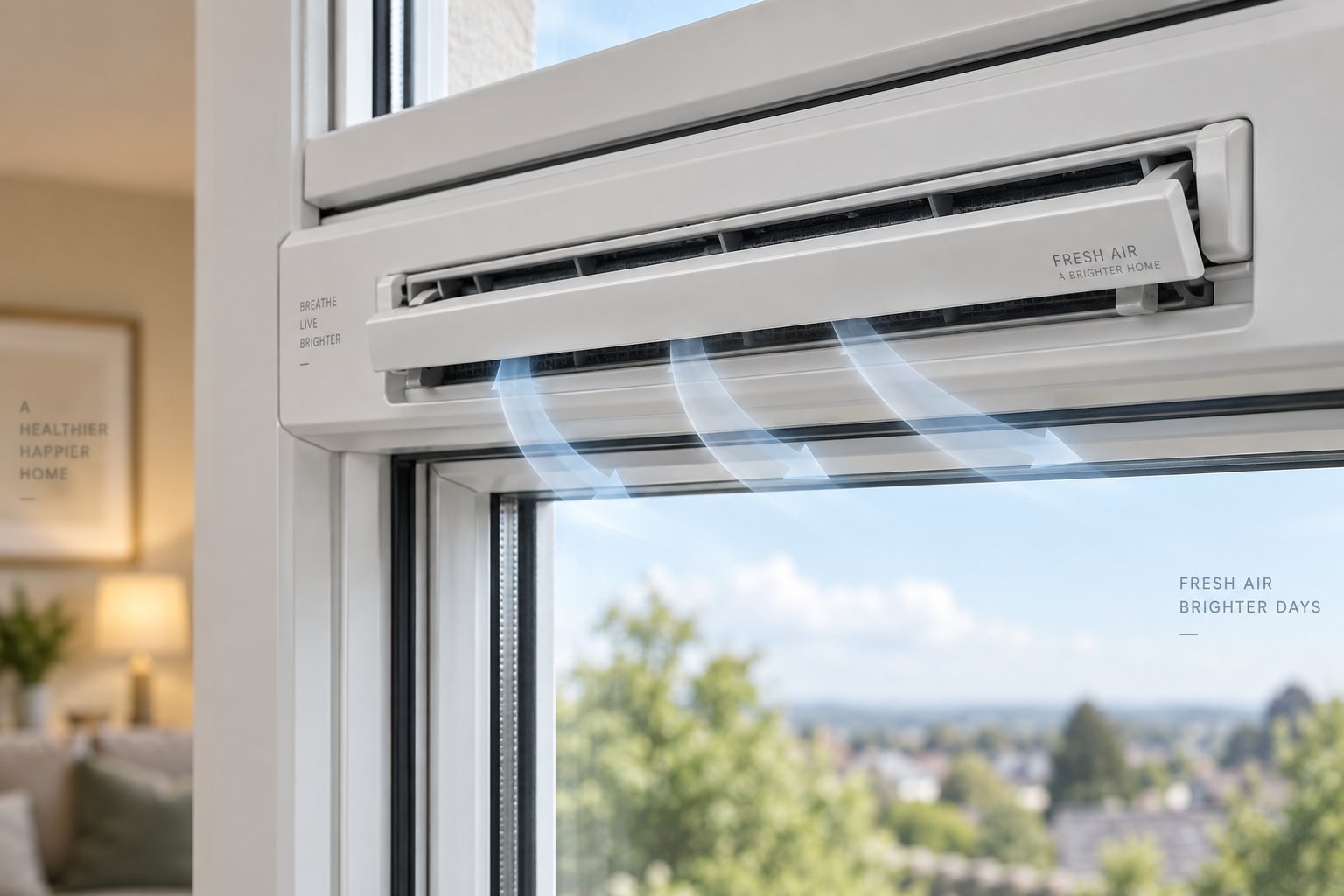
Trickle vents installed in window frames are the most common and practical way to achieve this. They provide exactly the kind of passive, always-on ventilation that keeps indoor air fresh and glass dry — even while you sleep with every window locked.
Trickle vents are small openings integrated into the head of a window frame — usually a narrow, slotted channel running along the top of the frame profile. When open, they allow a controlled volume of air to pass between indoors and outdoors even while the window itself is fully closed, locked, and secure. As Sternfenster explains, trickle vents help a home "breathe continuously," which is something many modern airtight buildings struggle with on their own.
The mechanism is straightforward. Warm, moist indoor air naturally rises. When it reaches the trickle vent at the top of the window frame, a small portion escapes to the outside while drier external air enters low in the room. This gentle circulation prevents humidity from building to condensation-triggering levels overnight. You do not feel a draft. You do not hear a whistle. You just wake up to dry glass.
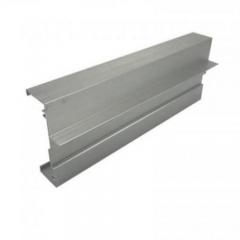
Trickle vents work with both aluminium and uPVC window systems, making them a versatile option regardless of your frame material. For homeowners planning window replacements — or fabricators specifying components for new builds — choosing frames with purpose-built trickle vent compatibility is one of the smartest ways to reduce condensation on windows at the design stage. Products like Shengxin Aluminium's uPVC Window Trickle Vent are designed to integrate flush with both aluminium and uPVC frame profiles, maintaining clean aesthetics while delivering the airflow needed to keep windows clear. For replacement-window buyers and fabricators alike, specifying a dedicated background ventilation component like this builds condensation prevention directly into the window system rather than treating it as an afterthought.
Most modern trickle vents also include a manual slider or flap, giving you control over the airflow. On particularly windy days, you can partially close them to limit drafts. On still, humid nights — the conditions that produce the heaviest condensation — leave them fully open. Modern designs are engineered to minimize noise transfer, addressing the common concern that preventing condensation on windows with open vents means letting in street noise. In practice, the slot is narrow enough that sound reduction remains strong.
Background ventilation handles the slow, steady moisture that accumulates throughout the day and night. But kitchens and bathrooms produce sudden, concentrated bursts of humidity — a hot shower or a pot of boiling pasta can spike a room's moisture level within minutes. Trickle vents alone cannot evacuate that volume fast enough. This is where extractor fans serve as the essential active complement.
If you want to how to avoid condensation on windows in rooms that generate heavy steam, the rule is simple: always run the extractor fan during cooking or showering, and keep it running for 15 to 20 minutes after you finish. That additional run time clears residual moisture before it migrates into hallways, bedrooms, and other closed rooms where it condenses on cold glass overnight. Close the kitchen or bathroom door while the fan runs to contain the humid air and let the extractor pull it outside rather than pushing it deeper into the house.
If your extractor fan is weak, noisy, or non-functional, upgrading it is one of the highest-impact changes you can make. A modern, quiet extractor with a humidistat sensor will activate automatically when moisture levels rise — a hands-free way to avoid condensation on windows in the rooms that produce the most steam.
Combining trickle vents for continuous background airflow with extractor fans for peak-moisture moments creates a layered ventilation strategy. Together, they prevent humidity from ever accumulating to the point where cold glass triggers condensation. It is the most effective approach to how to prevent condensation on windows without relying on nightly rituals or expensive equipment.
Ventilation gives moisture an exit. But there is another half of the equation that most people overlook entirely — how the temperature inside your home behaves overnight, and why letting your rooms go cold after the heating switches off practically guarantees that even well-ventilated windows will drip by dawn.
You have improved your ventilation. You have tracked down your moisture sources. Your hygrometer is showing progress. And yet, on the coldest nights, condensation on windows in winter still appears. Why? Because ventilation only addresses one half of the condensation equation — the moisture side. The other half is temperature. Specifically, the temperature of your window glass relative to the dew point of your indoor air. And that temperature is largely determined by how you heat your home after dark.
Most people treat heating and condensation as completely separate issues. They are not. Your heating schedule has a direct, measurable impact on whether your windows drip by morning — and a simple adjustment to how your thermostat behaves overnight can be more effective than any product you could buy.
Picture what happens when you head to bed at 10 p.m. and the heating clicks off. Room air temperature begins to drop — slowly at first, then more noticeably as the hours pass. By 3 a.m., your living room might be several degrees cooler than it was at bedtime.
Here is the critical detail most people miss: while air temperature falls, the moisture content of that air stays exactly the same. You have not removed any water vapor — the air simply got colder. And colder air has a lower capacity to hold moisture. The result? Relative humidity rises sharply, even though not a single extra drop of moisture entered the room. A room that measured a comfortable 50 percent humidity at 68°F can climb above 65 percent at 60°F with no change in actual moisture levels. As one Green Building Advisor discussion highlights, changing temperature alone shifts relative humidity without affecting the dew point — meaning the condensation threshold stays fixed while conditions around it worsen.
Meanwhile, your window glass is dropping even faster. Glass is thin. It conducts heat readily. It is the least insulated surface in any room. While your walls, floors, and furniture cool gradually thanks to their thermal mass, window panes track outdoor temperatures almost in real time. On a freezing night, interior glass surfaces can plummet well below the dew point within hours of the heating shutting off.
The combination is devastating: rising relative humidity meets plummeting glass temperature. The gap between the dew point and the glass surface widens dramatically, and condensation — or even ice in extreme cold — is virtually guaranteed by morning. This is exactly why moisture on windows in winter tends to be heaviest on the coldest nights and worst in homes where the heating shuts off completely after bedtime.
The fix is surprisingly simple. Instead of letting your home cool to ambient temperature overnight and then blasting the heating back on in the morning, maintain a consistent low background temperature through the night. You are not trying to keep the house at daytime comfort levels — just preventing the steep temperature plunge that triggers the humidity spike and glass temperature crash.
In practical terms, this means setting your thermostat to hold a modest overnight minimum rather than switching off entirely. Keeping rooms even a few degrees warmer than they would otherwise drop accomplishes two things simultaneously. First, it slows the rise in relative humidity by keeping air temperature from falling so far. Second — and more importantly — it keeps the inner surface of your window glass above the dew point for longer, which is the single condition that prevents condensation from forming.
Worried about the energy cost? The reality is less alarming than it sounds. Reheating a house that has gone completely cold overnight demands a significant burst of energy as your boiler or furnace works hard to raise every surface — walls, furniture, floors — back to temperature. Maintaining a gentle baseline uses less energy than most homeowners expect, because the heating system barely needs to cycle on. It is the difference between keeping a pot simmering and reboiling it from cold. For anyone searching for how to stop winter window condensation, this overnight thermostat adjustment is one of the most cost-effective strategies available.
If you want a specific starting point, try setting your overnight temperature no more than 5 to 8 degrees Fahrenheit below your daytime setting. Monitor your hygrometer and your windows over a few mornings. You will likely find a sweet spot where condensation on the windows in winter drops significantly without a noticeable impact on your heating bill.
Not every home responds to this strategy equally. The type of windows, frames, and insulation you have determines how aggressively glass temperature drops overnight — and therefore how much heating compensation you need.
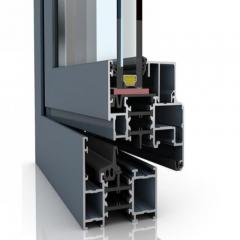
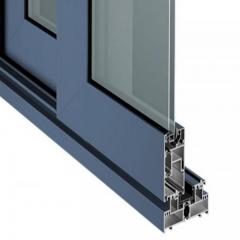
Frame material matters too. Aluminium frames without a thermal break are excellent conductors of cold — they transfer outdoor temperatures to the indoor frame surface rapidly, creating cold spots where condensation and even ice can form at the frame edges. uPVC and timber frames insulate far better, keeping the entire window assembly warmer. If you have older aluminium-framed windows, you may need a slightly higher overnight temperature to compensate for that thermal bridging.
Finally, consider your home's overall insulation. Older properties with poor wall or loft insulation lose heat faster, meaning the overnight temperature drop is steeper and more sudden. In a well-insulated modern home, the same thermostat setting might hold temperatures comfortably for hours after the heating cycles off. In a drafty Victorian terrace, that same setting could be overwhelmed within an hour. Knowing how to avoid condensation on windows in winter means understanding that your heating strategy must match the thermal performance of your specific building — there is no universal number that works for every home.
Adjusting your heating is the last major lever you can pull. But with ventilation, humidity control, and temperature management all working together, how do you know which combination delivers the best results for your budget? Laying every option side by side — with honest ratings for cost, effort, and effectiveness — makes that decision far clearer.
Ventilation, humidity control, heating strategy — you now understand the mechanics behind every major approach. But knowing how to stop window condensation and actually choosing the right fix for your situation are two different things. Your budget, your living arrangement, and your willingness to invest in permanent upgrades all shape which condensation solutions make sense for you. A renter with six months left on a lease needs a very different game plan than a homeowner renovating window frames.
The table below puts every major option side by side so you can compare at a glance. No vague advice — just honest ratings for effectiveness, cost, effort, and who each solution suits best.
| Solution | Effectiveness | Cost Level | Effort to Implement | Suitability |
|---|---|---|---|---|
| Window trickle vents (e.g., Shengxin Aluminium's uPVC Window Trickle Vent for aluminium and uPVC frames) | High | Medium | Moderate (retrofit) / Easy (new build) | Homeowners & fabricators |
| Electric dehumidifier | High | Medium | Easy | Both renters & homeowners |
| Extractor fan upgrades | High (in kitchens/bathrooms) | Medium | Moderate | Homeowners |
| Insulation film applied to glass | Medium | Low | Easy | Both renters & homeowners |
| Double-glazing upgrade or sealed unit replacement | High | High | Involved (professional install) | Homeowners |
| Disposable moisture absorbers | Low | Low | Easy | Both renters & homeowners |
| Consistent overnight low heating | Medium-High | Low (ongoing energy cost) | Easy | Both renters & homeowners |
| Behavioral changes (covering pans, drying clothes outside, closing doors) | Medium | Free | Easy | Both renters & homeowners |
A few things jump out immediately. Trickle vents rank at the top because they address the root cause of window condensation — inadequate ventilation — rather than just treating symptoms. A purpose-built background ventilation component like Shengxin Aluminium's trickle vent integrates directly into the window frame profile, delivering continuous passive airflow without any ongoing effort or running costs. For anyone asking how can you prevent condensation on windows permanently, this is the answer that keeps working year after year with zero maintenance.
Electric dehumidifiers also score high for effectiveness, but they come with ongoing electricity costs and require you to empty water tanks or manage drainage. They are an excellent tool — especially overnight — but they are treating the air rather than fixing the ventilation gap that let humidity build in the first place.
Disposable moisture absorbers and insulation film sit at the lower end. They help, but expecting them to solve serious condensation on their own is like putting a bandage on a leaking pipe. They are supplementary tools, not primary condensation solutions.
How do you fix condensation on windows if you rent your home and cannot modify the building? Focus on what you can control. An electric dehumidifier paired with behavioral changes — covering pans while cooking, drying clothes outside or near an open vent, keeping bedroom doors cracked at night — delivers strong results without touching the property. Add a budget insulation film kit to your worst windows for extra warmth on the glass surface, and you have a solid three-pronged strategy that keeps your deposit intact.
Homeowners have more options and should think longer term. Trickle vent installation, extractor fan upgrades, and glazing improvements all target the structural causes of what causes window condensation. These require upfront investment, but they pay dividends every winter — and they protect your property from the mold, damp, and frame damage that persistent moisture creates over time.
Here is the most important takeaway: no single fix works as well alone as two or three approaches working together. The most effective condensation control strategy combines a permanent ventilation improvement (trickle vents), a behavioral shift (managing moisture sources), and a heating adjustment (maintaining gentle overnight warmth). Each layer reinforces the others. Trickle vents remove moisture continuously. Behavioral changes reduce the volume of moisture entering the air. Consistent heating keeps glass warm enough to stay above the dew point. Stack all three, and you are not just reducing window condensation — you are eliminating the conditions that allow it to form.
Choosing the right combination gives you dry windows and a healthier home. But what happens if you have tried everything and condensation persists — or if you are noticing something more concerning than water on the glass, like dark mold creeping across your window frames? Some situations cross the line from a DIY fix into territory that demands professional attention and carries real health consequences.
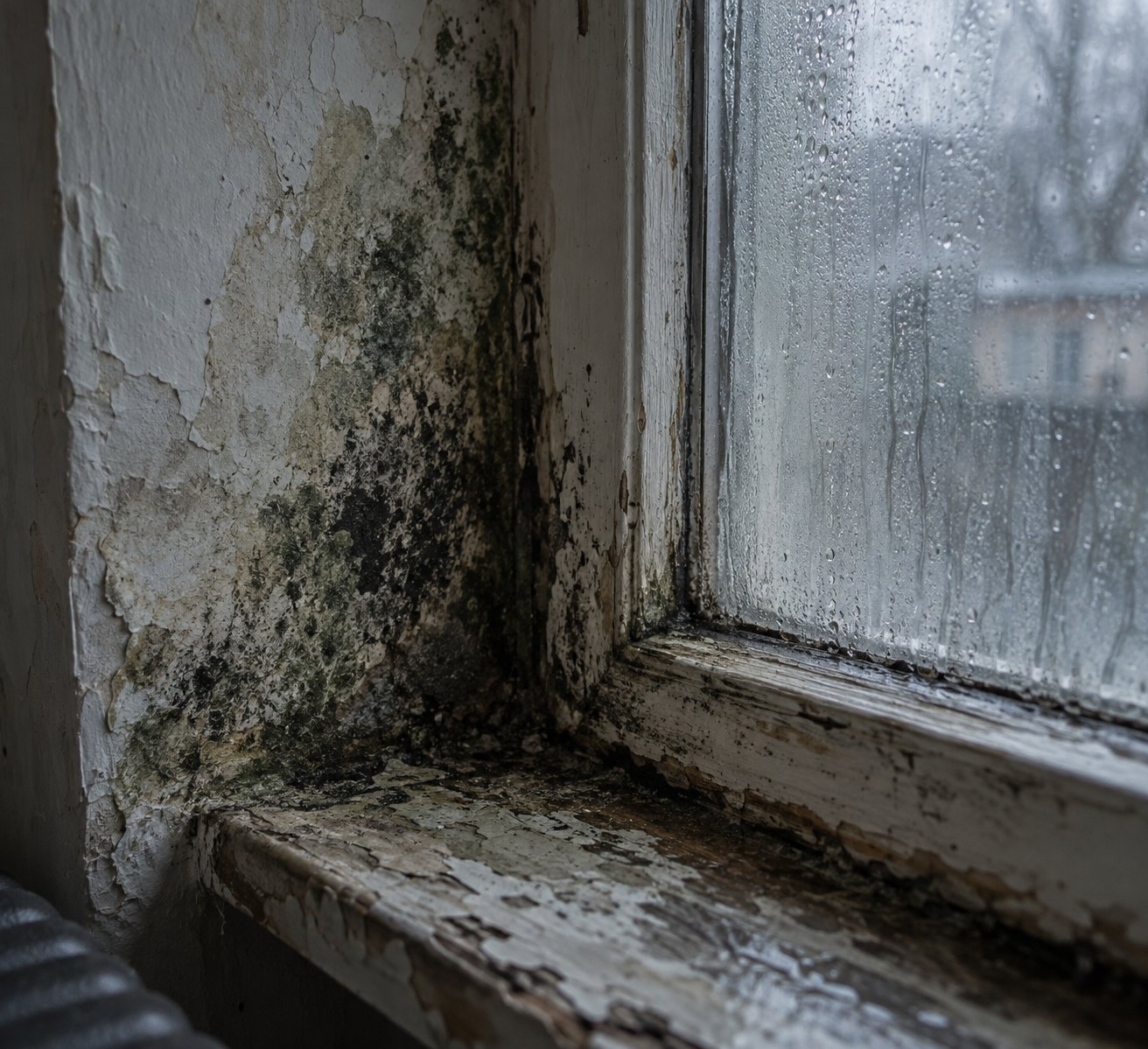
Dark patches spreading across window frames. A musty smell that lingers no matter how often you clean. A child's cough that never quite clears up during winter. These are not just annoyances — they are warning signs that condensation in home environments has crossed from a cosmetic issue into a genuine health concern. If your window has condensation inside night after night and you have been putting off addressing it, this is the section that should change your mind.
Condensation itself is just water. Harmless enough on its own. But water that sits on window frames, sills, curtains, and surrounding walls for hours every day creates exactly the damp conditions that mold needs to colonize and spread. Black mold — along with dozens of other mold species — thrives in environments where relative humidity stays elevated and surfaces remain wet. Your condensation-soaked window frames are a five-star hotel for mold spores that are already floating invisibly through your indoor air.
The health implications are serious. The American Lung Association confirms that exposure to mold can trigger allergic reactions and asthma symptoms in people who are allergic to mold. Even without a diagnosed allergy, anyone exposed to airborne mold particles may experience irritation of the eyes, skin, nose, throat, and lungs. Specific symptoms linked to mold exposure include worsening of asthma, persistent coughing, wheezing, nasal congestion, sore throat, and sneezing.
Children, elderly people, and anyone with asthma or a compromised immune system face the highest risk. A bedroom where condensation inside windows goes untreated for weeks can develop mold on window frames, curtain hems, and the wall surface directly around the glass — exactly the zone where a sleeping person breathes for eight consecutive hours every night. Mold from window condensation does not stay confined to the glass. Given enough time and moisture, it migrates onto plaster, wallpaper, and soft furnishings.
Condensation is not just a cosmetic nuisance. Left untreated, it creates the damp conditions that lead to mold growth — a recognized indoor air quality hazard with documented respiratory health consequences.
If you have been wondering why are my windows sweating every morning and dismissing it as a minor seasonal irritation, consider this: the American Lung Association recommends keeping indoor humidity below 50 percent specifically to prevent mold, and identifies inadequate ventilation and condensation as key contributors to unhealthy indoor moisture levels. Mold condensation windows are not just an aesthetic problem — they are a health environment problem.
The ventilation improvements, dehumidifiers, and heating adjustments covered in this guide will solve the vast majority of interior condensation problems. But some situations go beyond what DIY measures can address. If you notice any of the following, it is time to call a qualified damp specialist or professional window installer:
These situations demand assessment by someone who can distinguish between condensation and mould on windows caused by indoor humidity versus moisture intrusion from building defects. A qualified damp surveyor will use moisture meters, thermal imaging, and their experience to pinpoint the true source — saving you from spending money on fixes that target the wrong problem.
Misinformation about condensation is everywhere, and following bad advice can actually make your problem worse. Here are three persistent myths worth busting:
Myth 1: Burning candles reduces condensation. This is one of the most popular social media tips — and one of the most counterproductive. Burning a candle produces heat, yes, but combustion also generates water vapor as a byproduct. You are literally adding moisture to the air while trying to remove it. Real-world testing by Homes & Gardens confirmed that lighting candles on a condensation-affected windowsill produced zero improvement after 45 minutes, earning a verdict of 1 out of 10 for effectiveness. Save the candles for ambiance, not moisture control.
Myth 2: Condensation only happens with cheap windows. This is flatly wrong. Condensation forms whenever indoor humidity exceeds the dew point on any glass surface — regardless of whether that glass cost $50 or $5,000. Premium triple-glazed windows with argon gas fills and warm-edge spacers are more resistant because their inner pane stays warmer, but they are not immune. In extremely cold conditions or high-humidity homes, even top-tier glazing can develop mold on windows from condensation. The quality of your windows determines your margin of tolerance, not whether condensation is physically possible.
Myth 3: Opening windows in winter is wasteful and pointless. Controlled ventilation through trickle vents or a briefly cracked window loses far less heat than most people assume. The energy cost of a small, continuous air exchange is minimal compared to the expense of mold remediation, replacement window sills, repainting water-damaged walls, or treating health problems caused by prolonged mold exposure. The real waste is sealing your home so tightly that moisture destroys it from the inside.
Condensation inside windows is a solvable problem. This guide has walked you through every layer of the solution — from diagnosing your specific condensation type to measuring humidity, applying quick overnight fixes, improving ventilation with trickle vents, adjusting your heating strategy, and comparing every option by cost and effectiveness. The key is stacking multiple approaches: reduce moisture at the source, give it a path out through background ventilation, and keep your glass warm enough to stay above the dew point. Do those three things consistently, and dripping windows become a problem you used to have.
Your windows collect condensation overnight because warm, moisture-laden indoor air contacts the cold glass surface. When heating switches off or drops, the glass temperature falls below the dew point — the temperature at which airborne moisture turns to liquid. Activities like breathing, closed bedroom doors, and indoor laundry drying raise humidity levels while you sleep, making the problem worse. Measuring your indoor relative humidity with a hygrometer and keeping it between 40 and 55 percent is the most reliable way to prevent morning condensation.
Yes, an electric dehumidifier is one of the most effective overnight fixes because it physically extracts water vapor from the air, lowering relative humidity toward the 40-55 percent target range. Place it in the worst-affected room — typically a bedroom or the room where clothes dry indoors. Disposable moisture absorbers using calcium chloride crystals offer a budget alternative but work much more slowly and cannot handle heavy condensation. For best results, combine a dehumidifier with background ventilation such as trickle vents to address the root cause rather than just treating symptoms.
Interior condensation appears on the room-facing side of the glass and is caused by excess indoor humidity or poor ventilation — it is fully fixable through better airflow, humidity management, and heating adjustments. Condensation between double-glazing panes appears as a foggy haze trapped inside the sealed unit, which means the perimeter seal has failed. No ventilation or dehumidifier will resolve it; the sealed glass unit must be professionally replaced. A third type, exterior condensation on the outside of the glass, actually indicates good thermal insulation and requires no action.
Trickle vents are one of the highest-rated solutions for preventing overnight condensation because they deliver continuous, passive airflow even when windows are fully closed and locked. Installed in the window frame head, they allow moist indoor air to escape while drier outside air enters, preventing humidity from building to condensation-triggering levels. Purpose-built components like Shengxin Aluminium's uPVC Window Trickle Vent integrate flush with both aluminium and uPVC frame profiles, making them ideal for new builds or replacement windows where condensation prevention is built into the system from the start.
Persistent window condensation creates the damp environment that mold needs to grow on frames, sills, curtains, and surrounding walls. According to the American Lung Association, mold exposure can trigger allergic reactions, worsen asthma symptoms, and cause irritation of the eyes, nose, throat, and lungs. Children, elderly individuals, and those with respiratory conditions face the highest risk. If mold has spread beyond the window area, covers more than about 10 square feet, or you notice a persistent musty odor, professional assessment by a qualified damp specialist is recommended.



 serviço on-line
 0086 136 3563 2360
 sales@sxalu.com
 +86 136 3563 2360
 português
 English
 français
 Deutsch
 русский
 español
 العربية
 ไทย
ไทย Việt
Việt Українська